
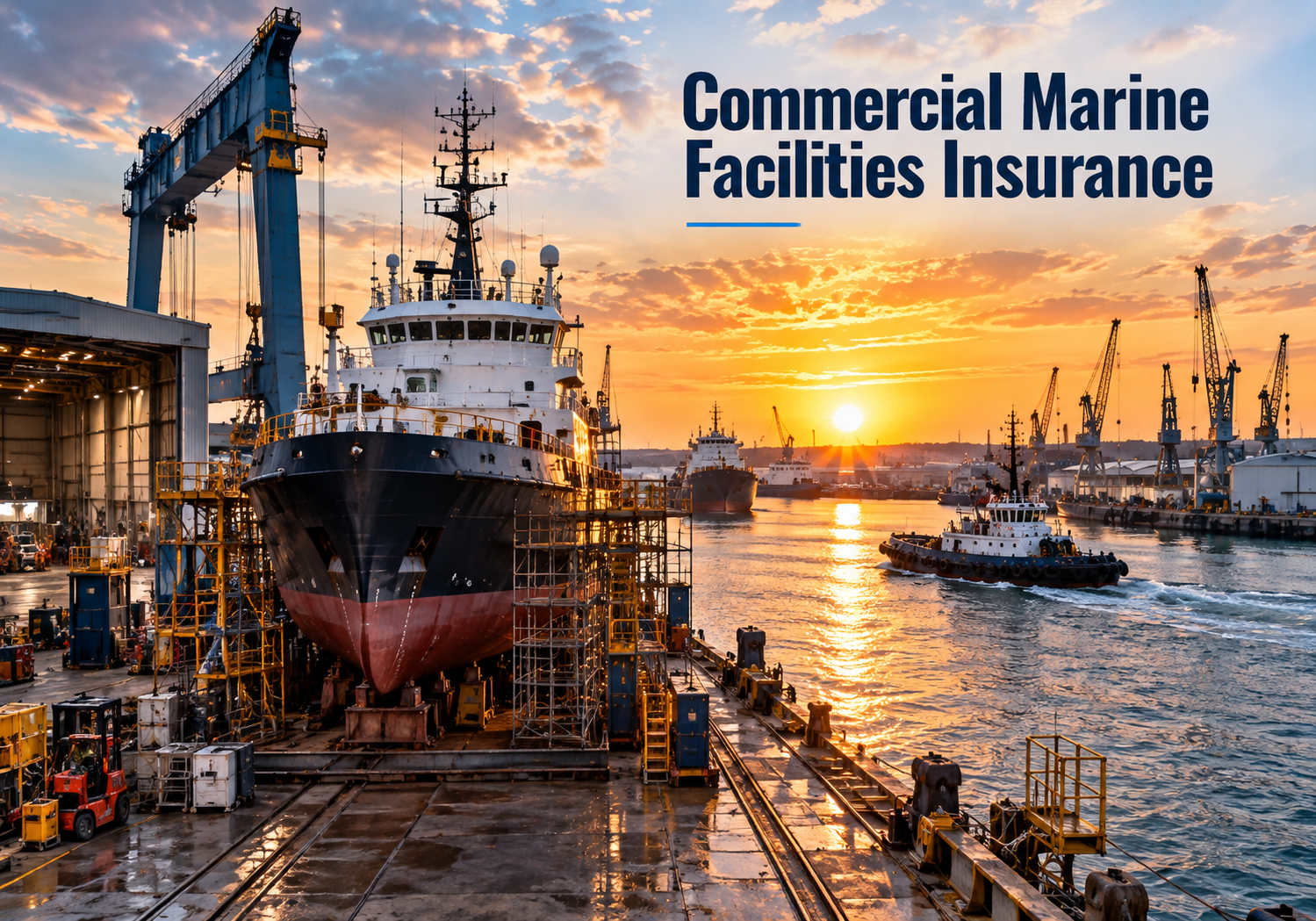
Commercial Marine Facilities Insurance
Commercial marine facilities operate at the intersection of land, water, vessels, cargo, equipment, employees, contractors, and customers. For shipyards, terminals, repair facilities, docks, and other waterfront operations, that combination can create complex property and liability exposures that require a coordinated approach to commercial marine insurance.
A single incident at a marine facility can affect far more than one piece of property. Vessel damage, employee injuries, customer property, pollution events, heavy equipment accidents, fire, storm damage, or interrupted operations can involve multiple policies and potentially significant financial exposure.
Protecting Shipyards, Terminals & Waterfront Operations
Marine facilities can differ dramatically in size and operation, but many share one characteristic: several different types of risk exist in the same working environment.
Property, equipment, vessels, employees, customers, contractors, cargo, and environmental exposures may all be present at the same location. A well-structured insurance program should consider how those exposures interact rather than treating each risk independently.
Marine Facilities Face Risks on Both Land and Water
Unlike many traditional commercial businesses, waterfront operations may have significant exposures extending beyond the physical boundaries of the facility. Employees may work aboard vessels, machinery may move between land and water, customer property may remain in the facility’s care, and operations may take place on docks, piers, dry docks, terminals, or adjacent waterways.
The result is an operating environment where traditional commercial insurance and specialized marine insurance may need to work together.
Understanding where one policy ends and another begins can be particularly important when an operation involves vessels, waterfront property, cargo, marine contractors, or work performed over navigable waters.
Commercial Marine Facilities May Include
Shipyards • Marine Terminals • Stevedores • Ship Repairers • Wharfingers • Docks & Marinas • Dry Docks • Boat Yards • Marine Contractors • Cargo Handling Facilities • Offshore Support Facilities and other waterfront operations.
Property & Equipment at Marine Facilities
Marine facilities can contain substantial concentrations of property and equipment. Buildings, docks, piers, cranes, lifts, forklifts, tools, machinery, storage areas, electrical systems, and specialized marine equipment may all be essential to daily operations.
Fire, wind, flooding, equipment breakdown, collision, and other covered causes of loss can create significant repair or replacement costs. In addition to the direct physical damage, a serious property loss may interrupt operations and affect contracts, customers, employees, and revenue.
Facility owners should periodically review property values, equipment schedules, improvements, replacement costs, and changes made since the insurance program was originally established.
Ship Repairers & Customer Vessel Exposure
Facilities that repair, service, maintain, modify, store, or otherwise work on vessels can assume responsibilities for valuable customer property.
A vessel may be in a facility’s care while work is being performed, while it is being moved, or while it is stored at the location. Damage involving a customer vessel can create both property and liability questions depending on the circumstances and the insurance program in place.
The type of work being performed matters. Welding, mechanical repairs, electrical work, painting, fabrication, engine service, hauling, launching, and other activities can present very different loss scenarios and underwriting considerations.
Terminal, Wharfinger & Cargo Exposures
Terminals and other waterfront facilities may handle cargo, vessels, containers, equipment, and property belonging to customers or third parties. The responsibilities assumed by the facility can vary depending on its services and contractual arrangements.
Operations involving loading, unloading, storage, movement, or temporary custody of cargo can create exposures that extend beyond ordinary premises liability.
Understanding exactly what property is being handled, who owns it, where responsibility transfers, and what contracts require can be an important part of reviewing the facility’s insurance program.
Pollution & Environmental Liability
Waterfront operations can face environmental exposures involving fuel, oil, chemicals, waste, vessel operations, storage tanks, machinery, or accidental releases.
A pollution event can involve cleanup expenses, third-party property, regulatory requirements, environmental damage, legal expenses, and potentially significant operational disruption.
Because pollution exclusions can exist within other liability policies, marine facility operators should understand how environmental exposures are addressed within their overall insurance program.
MARINE FACILITY RISK REVIEW:
A facility’s insurance program should reflect the actual work being performed today. New equipment, expanded services, additional customers, larger vessels, new contracts, facility improvements, increased property values, or changes in cargo and operations can materially change the risk even when the business remains at the same location.
Employee & Maritime Workers’ Compensation Exposures
Employee exposures can be particularly complex within the maritime industry because the nature and location of an employee’s work may affect which workers’ compensation or maritime-related laws and coverages apply.
Employees may work on docks, aboard vessels, around cranes and heavy equipment, in repair areas, or over and adjacent to navigable waters. The specific duties being performed can be just as important as an employee’s job title.
Marine employers should work with qualified insurance professionals to evaluate their workforce, operations, and applicable coverage requirements.
Important Areas Marine Facility Owners Should Review
Marine insurance is highly dependent on the individual operation. A useful coverage review should examine both the physical facility and the activities taking place within it.
Contracts Can Change the Risk
Marine businesses frequently operate under contracts with vessel owners, contractors, terminal operators, suppliers, government entities, and other commercial organizations.
Those agreements may contain insurance requirements, indemnification provisions, additional insured requirements, waivers, liability limits, or other contractual obligations that can affect the insurance program.
A new customer or contract can therefore change an organization’s risk even when no new building, vessel, or piece of equipment has been added.
Business Interruption After a Marine Facility Loss
Physical damage is only one part of a serious marine facility loss. When a dock, crane, building, lift, terminal, or critical piece of equipment becomes unavailable, the resulting interruption can affect revenue and the facility’s ability to fulfill customer obligations.
Repair timelines may also be longer when specialized marine structures or equipment are involved. Replacement parts, engineering requirements, regulatory approvals, and specialized contractors can all influence how quickly an operation returns to normal.
Business interruption and related coverage should therefore be considered alongside the physical property being insured.
Excess & Bumbershoot Liability Protection
Marine losses can involve significant severity. Serious bodily injury, vessel damage, pollution events, contractual liability, and multi-party claims can potentially exceed primary liability limits.
Depending on the operation, excess liability or marine bumbershoot coverage may be considered as part of a broader insurance program designed to provide additional limits above certain underlying policies.
The appropriate structure depends on the facility, underlying coverage, contractual requirements, and potential severity of the exposures involved.
Questions Worth Asking Before Your Next Renewal
Have property or equipment values increased? Have you added cranes, lifts, docks, machinery, storage areas, or other major improvements? Are you servicing larger vessels or performing different types of work?
Have new customers or contracts changed your insurance requirements? Are you handling different cargo or assuming responsibility for additional customer property? Has your workforce, payroll, or employee activity changed?
Most importantly, do your property, marine liability, pollution, workers’ compensation, business interruption, excess, and other policies still work together around the operation you have today?
Marine Risk Rarely Fits Inside a Single Policy
A commercial marine facility may require several different types of insurance working together. Depending on the operation, this can include commercial property, marine general liability, ship repairers liability, wharfinger liability, pollution liability, inland marine, cargo-related coverage, workers’ compensation, commercial auto, business interruption, and excess or bumbershoot liability.
The goal is not simply to accumulate policies. The more important question is whether those policies address the actual exposures of the business and work together without leaving unintended gaps between them.
Commercial Marine Insurance Built Around the Facility
There is no single insurance program that fits every waterfront business. A shipyard repairing commercial vessels has different exposures than a terminal handling cargo, a marina storing vessels, or a contractor performing specialized work along the waterfront.
A useful marine facility insurance review starts with understanding the entire operation — the property, people, equipment, customers, contracts, vessels, cargo, environmental exposures, and the work being performed every day.
Discuss Your Commercial Marine Facility Insurance
Harper Kranz works with shipyards, terminals, marine contractors, repair facilities, and other waterfront businesses to understand their operations and evaluate insurance solutions around their individual risks.
If your facility has expanded, your services have changed, or you simply want another look at your current insurance program, a coverage review can help identify questions worth addressing before your next renewal.
IMPORTANT:
Insurance coverage varies by insurer, policy form, endorsements, exclusions, limits, deductibles, and the individual risk. This article is provided for general informational purposes only and does not constitute insurance, legal, or risk management advice. Coverage should be reviewed with a qualified insurance professional based on the specific operation.